
A kitchen countertop is one of the few surfaces in a home that rarely gets a break. It handles everything from morning coffee and meal preparation to grocery storage, baking, and everyday cleaning. Yet, homeowners often overlook its condition until stains become difficult to remove, edges start chipping, or the surface no longer complements the rest of the kitchen. Replacing an outdated countertop can change how the entire space looks and functions, but the material and installation process deserve equal attention.
Quartz has become a strong contender in American kitchen renovations because it offers design flexibility without demanding the same maintenance as several natural stone surfaces. Still, quartz countertop installation is not simply about choosing a slab with an attractive pattern. The condition of the cabinets, placement of seams, thickness of the material, and accuracy of fabrication all influence the finished kitchen. Understanding these details helps homeowners avoid common renovation mistakes and make choices that serve their households for years.
What Makes Quartz Different From Other Countertop Materials?
Quartz countertops are engineered stone surfaces made primarily from natural quartz minerals combined with resins, pigments, and other materials. Manufacturers process this mixture into slabs that offer consistent patterns, different colors, and various surface finishes.
This manufacturing process gives quartz an advantage when homeowners want a particular appearance throughout their kitchen. Natural granite and marble have variations that depend on the stone itself. Quartz, on the other hand, allows manufacturers to produce more predictable designs, including marble-inspired veining, concrete-like finishes, and solid colors.
However, appearance is only part of the difference. The engineered structure also creates a nonporous surface that does not readily absorb everyday spills. This makes quartz particularly useful in kitchens where cooking, cleaning, and food preparation happen throughout the day.
Homeowners should understand that quartz is not indestructible. Its resin content makes it vulnerable to excessive heat, and strong impacts can chip its edges. It offers excellent everyday performance when homeowners use it correctly, but it still needs sensible care.
Why Quartz Fits Modern American Kitchens
American kitchens serve several purposes beyond cooking. In many homes, they double as breakfast areas, homework spaces, informal dining rooms, and gathering spots. A countertop must therefore handle frequent use without making everyday maintenance difficult.
Quartz meets several of these practical requirements:
- It handles everyday spills more effectively
Coffee, cooking oil, fruit juice, and sauces are common kitchen spills. Because quartz has a nonporous structure, these liquids are less likely to penetrate the surface than they are with many untreated natural stones. Quick cleaning helps prevent residue from building up.
- It offers greater design consistency
Matching a countertop with cabinets, flooring, and backsplashes can be challenging. Quartz provides a wide selection of colors and patterns, making it easier to maintain a consistent design throughout the kitchen. This also helps when homeowners want a coordinated appearance across an island and surrounding countertops.
- It reduces routine maintenance
Unlike many granite and marble surfaces, engineered quartz generally does not require periodic sealing. Homeowners can maintain it with mild cleaning products rather than following a complicated treatment schedule.
- It works with different kitchen layouts
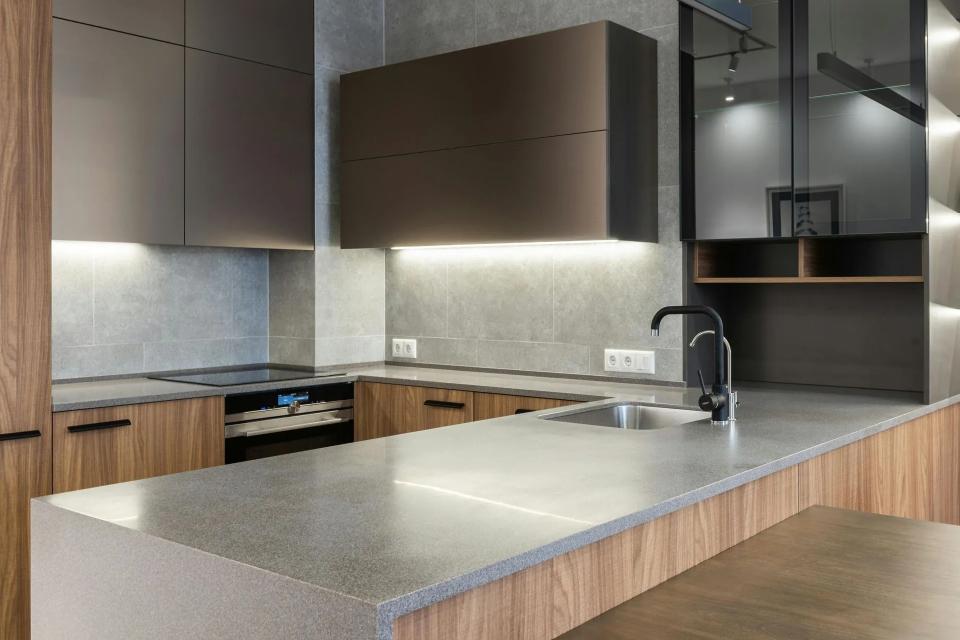
Quartz can accommodate straight countertops, L-shaped kitchens, U-shaped layouts, and islands. Custom fabrication allows installers to create openings for sinks, faucets, and cooktops while accounting for the dimensions of the existing space.
These benefits make quartz a practical option for homeowners updating older kitchens or planning a complete renovation. The material is especially useful when appearance and manageable upkeep carry equal importance.
What Happens During Quartz Countertop Installation?
A successful installation begins well before the slab reaches the kitchen. Quartz is heavy, and fabricators must account for every corner, opening, and connection point. Poor preparation can affect cabinet support, seam placement, and the final alignment.
Here is how the process generally works:
Cabinet Assessment and Surface Preparation
The first step involves checking whether the existing cabinets can support the countertop. Installers look for uneven surfaces, loose joints, water damage, and structural weaknesses.
This inspection matters because quartz distributes considerable weight across the supporting cabinets. If the base is unstable, the new surface may experience unnecessary stress. Homeowners replacing older countertops should address cabinet problems before ordering the new material.
Measurements and Slab Selection
After inspecting the kitchen, installers take detailed measurements and prepare a template. This includes the dimensions of the countertop, sink openings, appliance locations, corners, and overhangs.
Homeowners should finalize their sink and cooktop selections at this stage. Changing fixture dimensions after fabrication can lead to additional work and expenses.
Slab selection also requires attention to pattern direction and color consistency. For designs with prominent veining, fabricators may need to plan the slab arrangement carefully so adjoining sections look coordinated.
Fabrication and Edge Finishing
Fabricators cut the selected slabs according to the approved measurements. They create sink openings, appliance cutouts, and the required edge profiles.
Some popular edge options include
- Eased edges for a simple, contemporary appearance.
- Beveled edges for a defined geometric finish.
- Bullnose edges for a rounded profile.
- Ogee edges for a more traditional decorative look.
Fabrication requires specialized machinery and silica dust controls. Professional handling is important because cutting engineered stone can release respirable crystalline silica, which poses serious occupational health risks.
Placement, Seaming, and Final Inspection
Once fabrication is complete, installers transport the slabs and position them over the prepared cabinets. They align the sections, check the edges, and join adjoining pieces with suitable seam materials.
Seam placement deserves particular attention. A poorly positioned or visibly uneven seam can interrupt the countertop’s pattern and affect its appearance. Installers also check sink openings, overhangs, and the overall fit before completing the work.
Important Decisions to Make Before Installation
Two kitchens can use the same quartz color and still produce very different results. The difference often comes down to planning.
Before approving an installation, homeowners should consider the following details.
| Decision | Why It Matters |
| Slab thickness | Influences the countertop’s appearance, weight, and fabrication requirements. |
| Pattern direction | Helps maintain visual continuity across adjoining sections. |
| Edge profile | Changes the overall look and may affect fabrication costs. |
| Seam location | Determines how noticeable the joints will be. |
| Sink compatibility | Ensures the opening matches the selected sink and plumbing arrangement. |
| Island overhang | May require additional support depending on its size and design. |
| Cabinet strength | Helps prevent structural problems after installation. |
Budget planning is equally important. The total project cost includes more than the quartz slab. Fabrication, transportation, removal of the old countertop, sink cutouts, edge treatments, and installation labor can all influence the estimate.
Homeowners should request itemized quotations and confirm what the contractor includes. This makes it easier to compare proposals and understand where additional charges may arise.
Quartz Countertop Problems Homeowners Should Understand
Quartz offers several practical benefits, but overlooking its limitations can lead to disappointment.
One common mistake is treating the material like a heat-proof surface. Quartz can withstand normal kitchen activity, but placing hot cookware directly on it may damage the resin. Trivets are essential when handling hot pans and baking dishes.
Another concern involves direct sunlight. Prolonged exposure to UV rays can cause some quartz products to fade or change color. This is worth considering in kitchens with large windows or extensive outdoor exposure.
Homeowners should also avoid using the countertop as a cutting surface. Although quartz resists everyday scratches, sharp knives can still damage the finish. Heavy objects dropped near corners may cause chips, particularly around sink and cooktop cutouts.
A few simple precautions help prevent these problems.
- Use cutting boards for food preparation.
- Place hot cookware on heat-resistant mats.
- Avoid harsh chemicals and abrasive cleaning pads.
- Do not stand or sit on unsupported countertop sections.
- Follow the manufacturer’s care and warranty instructions.
These precautions protect the surface without making everyday kitchen use complicated.
Keeping Quartz Countertops in Good Condition
Quartz does not need an elaborate cleaning routine. In fact, one of its main advantages is that homeowners can maintain it with ordinary household cleaning practices.
For everyday cleaning, warm water, mild dish soap, and a microfiber cloth are generally sufficient. Sticky food residue should be removed before it hardens, while spills from coffee, sauces, and oils should be wiped away promptly.
There is also little reason to apply a stone sealer to most engineered quartz countertops. Their nonporous construction already provides resistance to moisture and staining. Using products that the manufacturer does not recommend may leave unwanted residue or affect the finish.
For stubborn marks, homeowners should check the manufacturer’s approved cleaning instructions rather than experimenting with strong chemicals.
Give Your Kitchen a More Practical Surface With the Right Installation
A countertop influences how a kitchen looks, but its real value becomes clear through everyday use. Quartz offers a combination of design consistency, stain resistance, and manageable maintenance that suits many American households. However, the material alone cannot guarantee a successful renovation. Accurate measurements, suitable cabinet support, thoughtful seam placement, and professional fabrication all contribute to the final result.
Colorado Field Services understands that residential improvements require careful planning and attention to the condition of the property. Homeowners exploring kitchen upgrades can discuss their project requirements with the team and consider suitable improvement solutions for their homes.
For those planning kitchen quartz countertop installation, the first step is to understand the kitchen’s existing layout, material requirements, and intended use. A well-planned renovation can create a countertop that looks right, supports daily activities, and remains practical long after the installation is complete. Contact Colorado Field Services to discuss your home improvement needs.
Frequently Asked Questions (FAQs)
- What are the disadvantages of quartz countertops?
Quartz can be sensitive to high temperatures because its resin content may react to direct heat. Prolonged UV exposure can also affect certain products. Additionally, heavy impacts may chip the edges, and professional fabrication is necessary because the material is difficult to cut without specialized equipment. - Is quartz better than granite for kitchen countertops?
Quartz offers a nonporous surface, consistent patterns, and relatively simple maintenance. Granite provides natural variations and generally handles direct heat better. Neither material is universally better. The right choice depends on cooking habits, design preferences, maintenance expectations, and the conditions in which the countertop will be installed. - How long do quartz countertops last?
With proper installation and routine care, quartz countertops can last for decades. Their lifespan depends on product quality, installation workmanship, daily usage, and maintenance. Avoiding direct heat, heavy impacts, and unsuitable cleaning products can help preserve the surface and its appearance. - Can quartz countertops crack or chip?
Yes. Although quartz is durable, it can crack under excessive structural stress or chip following a strong impact. Weak cabinet support, improper installation, and heavy pressure around unsupported sections can increase the risk. Professional measurements and proper support help prevent avoidable damage. - Do quartz countertops require special cleaning products?
No. Most quartz countertops need only mild dish soap, warm water, and a soft cloth for everyday cleaning. Homeowners should avoid abrasive cleaners and products containing harsh chemicals unless the manufacturer specifically approves them. Following the product’s care instructions helps maintain its original finish. - Can quartz countertops be installed over existing countertops?
In most cases, installers recommend removing the existing countertop before installing quartz. The cabinets need proper inspection, leveling, and preparation to support the new material. Installing quartz over an old surface can create structural and fitting concerns, so the contractor should assess the kitchen before recommending an installation method.
Category
 basement finishing
Bathroom Renovation
Blog Category
Concrete Patio Installation
Concrete Sidewalk Installers
Countertop Installation Services
Emergency HVAC Service
Exterior Painting Castle Pines
General Contractor
General Contractors
Granite Countertop
Granite Countertops
Heating System Installation
Home Air Quality Inspection
HVAC Maintenance Service
Indoor Air Quality
Interior Painting
Mold Remediation
mold remediation colorado
Painting Contractors
Poured Concrete Services
Quartz Countertop Installation
Quartz Kitchen Countertop Installation
Residential Concrete Services
Tenant Improvement
Uncategorized
Recent Posts